RSS Feed

Article Image Alt Text

Herbert Norman

MAURICE – A Graveside Service will be held Thursday, September 17, 2020 at 11:00 a.m. at St. Joseph Cemetery for Herbert “T-Black” Norman, 90, who died September 14, 2020 at Our Lady of Lourdes Regional Medical Center.
Interment will be in St. Joseph Cemetery.
He is survived by his loving wife of nearly 66 years, Anna Catalon Norman; their five children, Michael Norman (Linda Sonnier Norman) of Maurice, LA, Richard Norman (Emily Perkins Norman) of Carencro, LA, Pamela Norman Baggette (Stephen Baggette) of Rosenburg, TX, Sharon Norman Comeaux (Richard Comeaux) of Maurice, LA, Craig Norman (Kerry Francis Norman) of Lafayette, LA; 18 grandchildren; 28 great grandchildren; 2 great-great grandchildren; brother, Edwin Norman, Jr.; sister, Olita Mae Narcisse of LaMarque, TX and a host of nieces, nephews, cousins and friends.
He was preceded in death by his parents, Edwin Norman and Olita Boudreaux Norman; daughter, Joanna Norman Duhon; father-in-law, Eldridge Catalon; mother-in-law, Emma Mouton Catalon; siblings, Roosevelt Norman, Kerbet Norman, Clarence Norman, Velma Arceneaux, Rose Roy, Dorothy Norman, Sharbet Norman, Wilda Trahan, Hilda Perry, Florence Bushnell and Calvina Welch.
Sign the guestbook online at www.syrie.com
Arrangements have been entrusted to Syrie Funeral Home, Inc. of Lafayette, LA.

Article Image Alt Text

Erath City Hall

Erath residents complaining about high electricity bills

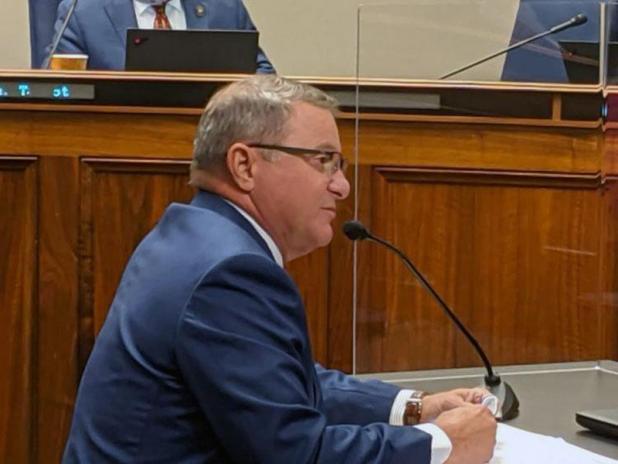
ERATH — After Tuesday night’s Erath Aldermen’s meeting, the Mayor and some aldermen stayed to answer questions that a handful of residents had about their electricity bills.
Residents had questions for Mayor Taylor Mencacci and a couple of aldermen as to why their electricity was higher than usual and what is “Fuel Adjustment cost,” which is also on the electrical bill.
Erath residents complaining about high electricity rates is a common practice during the summer months. Two years earlier, Erath resident Jason Connor was asking former Erath Mayor John Earl LeBlanc why the electricity was so expensive in Erath.
Today, Connor, the Mayor Pro Tem in Erath, and Mayor Mencacci are answering the same questions they asked the former Mayor and aldermen more than two years earlier.
Erath resident Jamie Meyers stood in front of the Erath aldermen and Mayor and wanted answers about his high electricity bill.
“That is what y’all ran on, saying y’all were going to lower the town’s electricity rates. What changed? Why are we OK?”
Mencacci said, “We are not OK.”
Erath is in its fourth year of a five-year contract with CLECO. The aldermen and Mayor are in the process of shopping for other electrical companies for lower rates.
Under the present contract with CLECO, Mayor Mencacci explained the town charges residents 4.9 cents per kilowatt per hour and 5.4 cents per kilowatt per hour for businesses.
That 4.9 percent is slightly higher than other towns the size of Erath. The Mayor explained why.
The Mayor explained to Meyers that Erath does not collect a lot of sales tax revenue or property tax revenue, which is used to fund the town’s budget.
Erath gets an average of $22,000 a month in sales tax compared to Maurice, which gets around $60,000. Gueydan brings in $19,000 a month.
For the entire year, Erath only collects $22,000 in property tax.
Because there are not many businesses in Erath, the town needs more revenue to help pay its city workers, including its police.
It uses 1/3 of the money the utility fund brings in to fund its entire town’s operations.
Meyers also wanted to know what is “Fuel Adjustment” cost that appears on the electrical bill.
The Fuel Adjustment cost is what CLECO charges each resident. Each month they charge could be 8 cents per kilowatt-hour to as high as 14 cents per kilowatt-hour.
CLECO calls that charge, “Demand Surcharge.” The definition of demand surcharge is “an extra amount that a customer is charged because a business has had to pay more for its energy.”
Because of the different amount CLECO can charge for Fuel Adjustment cost, Mencacci said that is why the charge fluctuates each month.
Mencacci also said the town has no control over what CLECO charges for fuel adjustment cost (Demand Surcharge).
Mencacci added, “It (the electricity bill) is frustrating.”

Article Image Alt Text

Photo by U.S. Department of Agriculture Forest Service
A photo taken with a drone shows downed trees in the Vernon Unit of the Kisatchie National Forest. The LSU AgCenter estimates that timber damage from Hurricane Laura totaled $1.1 billion.

AgCenter estimates ag, forestry losses from Hurricane Laura exceed $1.6 billion

CROWLEY — Hurricane Laura caused $525.4 million in damage to Louisiana farmers and $1.1 billion to the Louisiana timber industry, according to preliminary estimates by the LSU AgCenter.
Laura devastated 757,538 acres of timber from the southwest to northeast parts of the state, according to a report by AgCenter economist Kurt Guidry and AgCenter forestry specialist Michael Blazier.
In comparison, agricultural losses — including forestry, crops and fisheries — from hurricanes Katrina and Rita in 2005 totaled $1.5 billion.
Laura’s $1.6 billion total in losses for Louisiana agriculture will likely increase when damage estimates for the fisheries industry are completed by the Louisiana Department of Wildlife and Fisheries.
The damage in 2005 and this year are different, Guidry said. Laura was more of a wind event, while Katrina and Rita brought flooding along coastal Louisiana. Infrastructure damaged by wind was the big factor this year, and crops were not as affected this year as in 2005.
So was Laura the costliest storm for Louisiana agriculture?
“It’s going to be up there as one of the highest we’ve ever had,” Guidry said. “Based on the amount of infrastructure damage that occurred and the losses associated with timber, the total economic impact to the food and fiber sector from Hurricane Laura will be as large as or larger than any storm that I have developed estimates for since my time with the AgCenter.”
But the storm’s impact on crop production and farm revenues across all commodities has been surpassed by other storms or weather events like droughts that have resulted in more widespread and larger production impacts.
However, from a timber standpoint, Blazier said, Laura appears to be the most devastating storm to hit Louisiana, even more destructive than Katrina and Rita combined. “It’s demoralizing. I checked and checked and rechecked the figures, and if anything, it’s conservative,” he said.
Using data from aerial surveys by the Louisiana Department of Agriculture and Forestry, Vernon Parish was estimated to have the largest economic loss of timber at $360 million on 160,416 acres, followed by Rapides, Beauregard, Grant and Allen parishes, all estimated to have timber damage exceeding $100 million.
Calcasieu Parish had the highest forestry acreage damage total of 188,292 acres, but the lost timber value was estimated at $76.7 million.
The damage estimate includes national forests as well as privately owned land. Many landowners use timber revenue to supplement their retirement income, and this storm will affect people throughout the state, Blazier said. As an example, he said, one landowner with 42 acres of commercial timber estimated that half of their trees were destroyed.
The heaviest damage tracked the path of the storm’s eye as it went almost all the way to Arkansas as a hurricane. Anecdotal evidence suggests the worst damage occurred in forests that had been thinned recently. “There was just more wind that could come through those stands,” Blazier said.
The AgCenter report determined that only 10% of the downed pine trees can be salvaged and that none of the damaged hardwood trees are salvageable. Blazier said market demand for hardwood pulp is low.
Downed trees in Louisiana’s environment must be salvaged quickly because the wood deteriorates rapidly. “We have a very short window, maybe less than a month,” he said.
In addition, the report says Laura will have long-term effects on the timber industry, with increased debris resulting in more disease and insect pressure on surviving timber. Also, the debris will worsen the potential for wildfire outbreaks and increase the costs of establishing new tree growth.
The timber report considered only impacts from forest landowners’ standpoint, but mills and loggers also suffered infrastructure damage.
Most of the agricultural losses involve infrastructure damage, according to an agronomic crops report by Guidry. That report broke down the impacts on farmers into five categories:
Reduced production resulted in losses, $48.4 million.
Stored commodity losses, $6.9 million.
Livestock losses and forced liquidation, $1.4 million.
Increased crop production costs, $6.7 million
Infrastructure damage, $462 million.
The report says most damage was caused by wind. “Unlike other storms that resulted in widespread and prolonged flooding, Hurricane Laura moved quickly through the state with flooding being generally confined to tidal surge along the coast. However, excessive winds throughout Laura’s entire path through the state caused significant infrastructure damage.”
Wind caused row crops to lodge, or be blown over.

Rice
The state’s rice crop suffered most, the report says, with 74,000 acres affected for an economic impact of $28.5 million. Yield losses for the first and second crops are estimated at 1.7 million hundredweight, with average losses of 38% for the first crop and 37% for the second crop. Stored rice losses total $6 million. Electricity needed to power drying systems in storage bins was lost throughout southwest Louisiana, and some storage bins were damaged by winds. Increased harvest costs are projected at $1.3 million.

“There were also significant acres of rice that was in the flowering stage of its development,” the report says. “High winds during that time is expected to lead to reduced pollination and reduced overall production.”

Sugarcane
A 3.2% yield reduction is projected for the 182,000 affected acres for a total loss of 50 million pounds valued at $8.2 million. Replanting is needed on 1,224 acres, costing almost $700,000 and bringing the total economic impact estimated to $8.8 million.

Soybeans
Yield on 153,000 affected acres is projected to be decreased by 9.6%, or 828,000 bushels, costing more than $8 million. Increased harvest costs from downed soybeans is expected to cost farmers $1.3 million, bringing the total losses to $9.4 million.

Cotton
The total impact amount of $6.5 million results from an 11.2% yield decrease of 7.8 million pounds on almost 60,000 affected acres for a $5 million loss. The total includes an additional $1.5 million from increased harvest costs.

Crawfish
The estimate concludes that 5,000 acres of crawfish ponds are affected, with an estimated loss of 75%, or 2 million pounds, for a total impact of $2.7 million.

Corn
The report says almost 17,000 affected acres will have a 15% yield loss of 526,000 bushels, and an increased harvest cost of $124,155 for a total of $2 million in losses.

Other commodities
The report says 10,750 acres of hay production was affected, with a 32% yield loss and more than $800,000 in storage losses that will cost almost $1.5 million.
The loss of grazing days on 703,400 acres is expected to cost $1.4 million.
Pecan losses totaling $745,240 are figured with a 34% yield reduction on 3,904 acres for a crop reduction of 573,262 pounds.
The storm had minimal impact on sweet potatoes, with losses estimated at about $30,000.
Grain sorghum losses are estimated at almost $43,000.

Livestock
The total livestock economic impact is estimated at $1.8 million.
Most of that is from the economic impact on cattle producers, estimated at $1.2 million. The report bases that figure on 130 cattle deaths, costing $88,400; 5,775 animals liquidated, costing $785,400; and 36,675 head evacuated, costing $324,000.
In poultry, the estimated loss of 101,000 birds is projected to cost $545,400. Much of that resulted from power outages that shut down cooling systems needed to control temperatures in chicken houses.
A dozen horses died from the storm, and 530 were evacuated, bringing the total impact to $38,575.
Losses for sheep, hogs and goat were less than $1,000.

Infrastructure
Buildings and facilities carried the biggest part of Louisiana’s agricultural damage estimate with a value of $403.2 million. The report estimates that the storm damaged a third of the ag-related buildings and other structures across 13 parishes.
Also, the storm damaged 5,100 miles of fencing that will cost $58.8 million to repair or replace, according to the report.
Guidry said several aid programs are available through the Farm Service Agency.
“Also, for those parishes designated as disaster areas, emergency farm loans are typically made available,” he said.
Federal legislative action would be required for additional assistance. “In other storm events, there have been programs that have been made available,” Guidry said.

Article Image Alt Text

Contractors were in different parts of the parish removing debris. This contractor was in
Abbeville picking up only vegetative debris.

Debris removal underway in Vermilion Parish

Debris removal has begun in Vermilion Parish.
A contractor from out of state was hired by the Police Jury last week to remove all of the debris caused from Hurricane Laura.
The contractor will have trucks spread out throughout the parish picking up debris. On Monday and Tuesday, some trucks were in Abbeville and Erath. Others were in Pecan Island removing a lot of marsh grass.
The police jury asks residents to have Hurricane Laura related debris hauled to the side of the road.
The Police Jury has guidelines residents must follow when placing debris on the side of the road.
The significant guideline is to have the debris separated. (look at the photo on the right)
• Construction debris should be in one pile
• Tree branches, leaves, and plants should be in a separate pile.
• Appliances such as washer and dryer, stove, and dishwasher should be alone in a pile. The police jury is asking that refrigerator doors be sealed and secured.
• Hazardous waste such as a battery, paint, and cleaning supply are also to be in a different pile.
The Police Jury warns that if everything is thrown into one large pile, the contractor will not pick up the debris.
The contractors are bringing the debris to the parish landfill.
Removal of the debris in the parish is expected to take at least 30 days.

Article Image Alt Text

Erath has 80 players on its team. If the school gives two game tickets per player, that is 160 tickets.

Only 25% will be allowed into high school football games

Many will not be happy because they won’t be able to get in

Today, LSU is not the only stadium that will be allowed only 25 percent seating capacity in its football stadium. That rule also also applies for high school stadiums in Louisiana.
Gov. John Bel Edwards last week said that football stadiums, high school and college, will only be able to operate at 25 percent capacity when the regular season begins in October.
With the season less than 20 days away, coaches, principals and athletic directors are scrambling to figure out what to do and how to make it work.
The LHSAA is expected to come out with guidelines for high schools regarding the 25 percent rule. There is also a chance the governor could raise the percentage to 50 percent by Oct. 1
In the meantime, parish administrators in the central office have been meeting and talking to coaches and principals on the best way to handle the 25 percent capacity rule.
Assistant Superintendent Paul Hebert, who is the parish athletic director, said as of today, each school will have to sell advance tickets before the game. Once those tickets are soldout, no one will be allowed to walk up to the game and buy a ticket.
Some schools are looking at shrinking their band or football team to allow more tickets to be sold.

What to expect as of now

Abbeville High has a seating capacity of around 4,000. If only 25 percent is allowed inside the stadium, that is 1,000 people.
Here is where the problem lies
The band has to be included in that 25 percent. So, if Abbeville has 100 band members, that leaves 900 fans for tickets.
In the season opener, Abbeville entertains VC. Abbeville head football coach Roderick Moy was hoping to have at least 2,000 fans pack Wildcat Stadium. He is now looking at 900 fans (minus 100 for band), which is a loss of $8,000.
“That is a lot of tickets we will not be able to sell,” said Moy. “I was counting on having a great gate. The football program is in debt, and we need all of the funds we can make.”
Down the road in Erath, the coaching staff and principal are trying to find a solution.
EHS’s stadium sits just under 1,900 fans. At 25 percent, only 345 could sit on the home side and 116 on the visitor’s side.
There are 80 football players on the EHS team. If each player gets two tickets for their parents, that is 160 gone. Then there is the EHS band, and cheerleaders, which are another 150 students. If each student is allowed two tickets, that is another 300 gone. Between the football players, band members and cheerleaders, that is 450 tickets. At 25 percent, EHS stadium only sits 345 people on the home side and 116 on the visitor’s side. That means there are not enough tickets to give to parents of students attending the game.
“We are going to have to make some tough decisions on who gets tickets,” said EHS Principal Marc Turner.
Hebert said each school would decide on who gets tickets.
The players’ box on the sidelines will also expand to each 10-yard line, allowing players to keep a certain distance.
Fans must wear face coverings and sit in marked seats that allow for social distancing.
Another idea thrown around was moving a home game to a larger stadium in the parish. When Erath and North Vermilion meet, the game could be moved to Wildcat Stadium if the Wildcats are on the road.

Article Image Alt Text

Judge Perry

Judge Perry on new Louisiana State Supreme Court Technology Commission

New Orleans, LA – The Louisiana Supreme Court today announced the creation of the Louisiana Supreme Court Technology Commission.
A judge, who was raised in Kaplan, sits on the commission.
Kaplan resident Judge Jonathan Perry , along with Judge Susan Chehardy, represent the Louisiana Appeals Courts, on the technology commission.
“I am truly honored to be appointed by the Louisiana Supreme Court to serve on the technology commission, specifically representing the Appellate Courts,” said Judge Perry.” I will work hard to do my part.”
The Commission, which will be a standing commission of the Court, will consist of judges from throughout the state from various levels of the judiciary who will be charged with identifying technology needs, establishing goals for implementation, devising best practices, and suggesting necessary rule changes and steps towards implementation of articulated technology goals for the judiciary.
“In today’s environment of rapidly advancing technology, creating this Commission of legal minds committed to addressing how to best ensure the judiciary’s application and utilization of technological innovations will position us to better serve our citizens and to further advance Louisiana’s judiciary,” said Chief Justice Bernette Joshua Johnson.
24th Judicial District Court Judge Scott Schlegel will Chair the Commission, which will make recommendations to the Louisiana Supreme Court related to technology. Judge Schlegel was recently named the recipient of the American Legal Technology Award, earned by a court or judicial officer for displaying outstanding use of technology that achieves a significant benefit to the public.
Judge Schlegel was elected to the 24th Judicial District Court for the Parish of Jefferson, Division D, in May 2013, and was later appointed to the Court’s Management Committee.
He currently serves as the Chairperson of the Specialty Treatment Court Committee for the 24th JDC; has been appointed to serve on the Council of Specialty Court Judges of the Louisiana Supreme Court; the Executive Board of the Louisiana District Judges Association (LDJA); as Chair of the LDJA/Department of Corrections Liaison Committee; as Chair of the LDJA Technology Committee; and as a member of the Louisiana State Law Institute’s Criminal Code & Code of Criminal Procedure Committee.
Initial members who will serve a term of two (2) years from the date of this order are:
• Louisiana Supreme Court: Justice John Weimer; Justice Will Crain
• Louisiana Appeal Courts: Judge Susan Chehardy; Judge Jonathan Perry
• Louisiana District Courts: Judge Brady O’Callaghan; Judge Scott Schlegel
(Chairman); Judge Laurie Brister; Judge Marcus Hunter; Judge Nakisha Ervin-Knott;
Judge John LeBlanc; Judge Clayton Davis
• Louisiana Juvenile Courts: Judge Blair Edwards
• Louisiana Family Courts: Judge Hunter Greene
• Louisiana City Courts: Judge Bryan Haggerty; Judge Kelli Temple
For more information visit lasc.org or contact Louisiana Supreme Court Public Information Specialist/Coordinator Trina S. Vincent at tvincent@lasc.org or (504) 310-2590.

Article Image Alt Text

Eric Demetric Walker, Jr.

ABBEVILLE — A Celebration of Life for Eric Demetric Walker, Jr., 21, will be held on Saturday, September 19, 2020 at 12:00 Noon at Faith Hope Baptist Church. 407 Duroq Street, Abbeville, LA. Pastor B.K. Stevens will officiate the service.
“MASKS MUST BE WORN TO ENTER THE CHURCH”
Visitation will begin at 9:00 AM on Saturday at the church and will conclude at the time of the services.
Interment will follow in Greater Pleasant Green Baptist Church Cemetery (Green Street), Abbeville, LA.
Eric was born on Thursday, January 7, 1999 to his parents Eric Walker, Sr. and Lenora Johnson in Houston, TX. He attended schools in Harris County. He worked various jobs, lastly being a stockman at Krogers. He loved to rap, take pictures and play basketball. He was an avid fan of the Los Angeles Lakers. He was happy go lucky and was spoiled.
He was preceded in death by his grandmothers, Ethel Lee Taylor and Lillie Bell Davenport-Johnson. Eric’s life came to a sudden end on Saturday, September 5, 2020 in New Iberia, LA. “GONE TOO SOON”
Eric leaves to cherish his memory his parents, Eric Walker, Sr. and Lenora Johnson, both of Houston, TX; his four siblings, Ashehia Johnson of Tyler, TX, Ty’Janea Johnson, Brandon Johnson and Kelvin Davenport, all of Houston, TX; and his grandfathers, Jesse Robertson of Houston, TX and Curtis Johnson of New Waverly, TX; other survivors include his aunts, uncles, nieces, nephews, cousins many relatives and friends, who trust that God is our refuge and strength, a very present help in trouble.”
Personal condolences may be expressed to the family on our website: carneyfuneralhome.net
Arrangements are entrusted to Carney Funeral Home, Lafayette, LA.

Article Image Alt Text

Maxi Pierce has been open in Intracoastal City for 65 years.

65-year-old business in Intracoastal City plans to close; Maxie Pierce Grocery locking its doors on Sept. 30

When Maxie Pierce Grocery in Intracoastal City closes on Sept. 30, it will be for the last time after 65 years for this family business. If you want one last shrimp po-boy or fishing tackle on sale, you better get there soon.
The Boffys are hoping to sell the lot and building as a camp or office in the coming months.
The family business first opened as Maxie Pierce’s Restaurant in 1955.
Maxie and Estelle Pierce capitalized on the growing industries in Intracoastal City in the 1950s and 60s by also opening a filling station, boat launch, and grocery store in 1962.
They built a new bar and restaurant near the current public boat launch in 1969. Many locals enjoyed the restaurant through the 1970s into the early 1980s and have continued to patronize the grocery store for nearly six decades.
Becky Boffy started working weekends in the family businesses for her parents at the age of 12.
Along with her husband Denis, Boffy bought the grocery store from her father, Maxie Pierce, in 1992. When the Boffys took over, much of the business included supplying groceries for the oil and gas industry.
When the Boffys rebuilt the business after Hurricane Rita, they added a deli to provide breakfast and lunch to customers.“We want to thank our loyal customers in Vermilion and the surrounding parishes for many wonderful years. We will miss seeing our friends every day but are looking forward to spending more time with our grandchildren,” agreed Denis and Becky Boffy.

Article Image Alt Text

Joshua Listi (left) and Dominic Listi team up to build one of six
wooden tables.

Article Image Alt Text

John, Joshua and Carrie Listi

Article Image Alt Text

Joshua Listi (left) and Dominic Listi show off the finished tables.

Christian Service Center to benefit from Eagle Scout project

Joshua Listi builds 6 tables

Joshua Listi is one step closer to earning the rank of Eagle Scout.
Listi, the son of Carrie and John Listi, is a 17-year-old senior at Vermilion Catholic High School. He has been in scouting, both Cub Scouts and Boy Scouts, for the past 10 years.
Joshua is currently ranked a Life Scout in the Evangeline Area Council Boy Scout Troop 85 in Vermilion Parish.
On Aug. 22, Joshua completed his Eagle Scout Project in order to achieve the rank of Eagle Scout. Eagle Scout is the highest achievement or rank attainable in the Boy Scouts of America program.
Since its inception in 1911, only six percent of Scouts have earned this rank after a lengthy review process.
Joshua’s Eagle Scout project consisted of building picnic tables for the Christian Service Center in Abbeville, Louisiana. The Christian Service Center serves groceries and hot meals to needy families in Vermilion Parish.
Currently, the amount of seating inside the Café building and under the pavilion is insufficient for the number of people the Center serves.
With the help of donors, volunteers, and fellow Troop 85 Boy Scouts, they were able to build six 8-foot long picnic tables.
Joshua explained where he got the idea to build the tables.
“Back in November when I went to CSC to help serve, I noticed the overflow sitting outside under the pavilion with plates in their laps and
sitting on the ground even,” said Joshua. “I didn’t like that. I felt we could give them a more dignified place to sit and eat. Seeing the project come together and seeing the finished product is so awesome! I am really grateful to have the ability to do this. I hope it makes a difference.”
These tables will provide additional seating and dining space in the outdoor pavilion area for the patrons of Christian Service Center to use for years to come.
Joshua’s Eagle Scout Project was delayed for five months due to the Covid-19 pandemic. Therefore, he thought about how he could help the patrons, volunteers, and staff of the CSC remain safe during this pandemic.
Joshua went above and beyond just building the picnic tables for the Christian Service Center.
Since there were donation funds leftover from the picnic table fundraising, Joshua custom ordered and purchased a five foot long aluminum sink/handwashing station from DeHart Shipyard.
He was also able to hire a plumber, Jude Gooch, to install a water line and pipes to the outdoor sink.
The donations also allowed Joshua to purchase and install a soap and paper towel dispenser from Vermilion Janitorial. And finally, Casey White of Cajun Kutz, donated rocks to be laid under the sink to maintain a proper foundation. This outdoor hand washing station was placed under the pavilion as well, and will allow the patrons to wash their hands before receiving their meals and remain safe during this pandemic.
The work day for the Eagle Scout Project was successfuldue to an outpouring of generosity from several local businesses. Gulf Coast Bank, Abbeville Electric, Bank of Abbeville, and many friends and family members made donations towards the project.
Lowes of Abbeville donated safety goggles and work gloves for the workday. Lowes also donated face masks, rubber gloves, and hand sanitizer for the staff at the CSC to use while serving food daily to the patrons. Subway of Abbeville, Robies, Super-1 Foods, and Meche’s Donuts also donated breakfast, lunch, water, and snacks for the workers and volunteers to enjoy during the workday.
The project was largely successful due to the help and guidance Joshua received from his project coach, Dominic Listi.
With his help, Joshua was able to lead the volunteers and guide in the construction of the picnic tables. Dominic Listi of LISCO helped to provide the skills and tools for the project. LISCO also helped supply the lumber and materials, along with Minvielle Lumber Company.
Joshua said he is proud of the completion of his Eagle Scout Project and it wouldn’t have been possible without the generosity and support of the local community.
Joshua will soon be completing his Eagle Scout Board of Review as his final step in the process of becoming an Eagle Scout.

Article Image Alt Text

Front (left to right) ; Karina Patel, Emily Nguyen, Lyla Fletcher, Tai’Janae Green; Middle (left to right), Suzie Gamez, McKayla Lopez, Elle Hebert, Ny’Haylie Guidry, Niki Tran, Angela Brailey; Back (right to left) Coach Ashly Boudreaux, Jayla Hebert, Payton Brown, Nevaeh Willis, Kendra Davenport Emma Reynolds, Alexis Stelly, Abbie Mouton and Coach Lacey Meaux.

Abbeville Lady Wildcats begin season with no fans in stands

The Abbeville Lady Wildcats’ volleyball team opened the 2020 season in front of no fans or students cheering. Instead, the Abbeville gym had players, managers, two referees, Principal Brett Darby, coaches and the clock operator.
While the gym was not as noisy as it could have been, there was cheering going on.
For the Lady Wildcats, Thursday’s game was a season-opener against West St. Mary. Abbeville had only a handful of practices leading up to Thursday’s match.
This year’s Lady Cat team did not have much time to mesh with the departure of seven seniors. No scrimmages were leading up to the first match. Instead, the first game of the year was the first time these AHS girls played someone other than themselves.
The bad news is that the Lady Wildcats lost in three sets, 25-15, 25-19 and 28-26.
The good news is that each set they played, they improved.
In the first set, they lost by 10. In the second, it was only six points. And the third set Abbeville had a chance to win but ended up losing by two points.
It was positive showing for head volleyball coach Ashly Boudreaux.
“We only had three or four practices because of COVID-19,” said Boudreaux. “All you could do is work to get better. We came out nervous and the rotations were not right. We can fix those things. Today’s match was more like a scrimmage. It showed us what we need to work on.”
After dropping the first set, Abbeville rebounded in the second set and jumped out to a 6-1 lead. The lead went to 7-3 on Abbie Mouton’s serve.
But then Abbeville blinked and saw its big lead shrink to 8-6. West St. Mary tied it 9-9 and then the Lady Wildcats tied it again, 11-11 on Karina Patel’s serve.
Abbeville retook the lead 18-16 on a dink shot by Mouton. But after that, West St. Mary rallied and out scored Abbeville 9-1 to secure the win.
In the third set, Abbeville stayed close and tied it 20-20 and then got behind 23-20. Abbeville’s Makayla Lopez found a hole and Mouton smashed a serve that was not returned to make it a 23-23 game.
The Lady Wildcats took a 26-25 lead thanks to two West St. Mary errors with Alexis Stelly serving. Unfortunately, Abbeville could not finish off West St. Mary. They scored three straight points to hold off Abbeville (0-1).
Stelly led Abbeville in serving with five aces. Emma Reynolds and Abbie Mouton had each three aces. Payton Brown and Makayla Lopez both had one ace. Lopez led with three assists. Stelly, Lopez and Mouton had each a kill.

Pages

Vermilion Today

Abbeville Meridional

318 N. Main St.
Abbeville, LA 70510
Phone: 337-893-4223
Fax: 337-898-9022

The Kaplan Herald

219 North Cushing Avenue
Kaplan, LA 70548